

Don't Miss An Episode, Subscribe Now

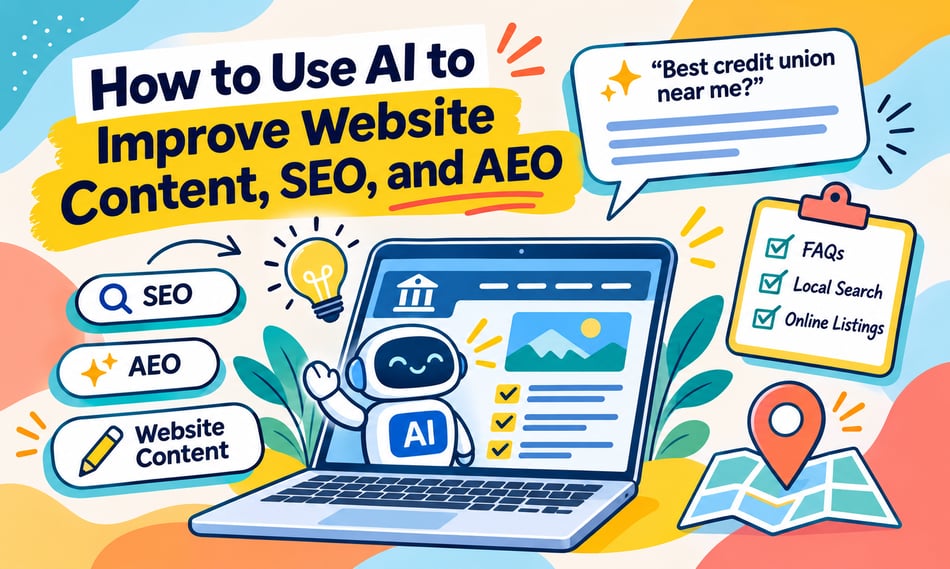
AI is changing how people find information online, and banks and credit unions need to rethink how they're creating website content. In this episode of the Hit Record Podcast, Meredith Olmstead and FI GROW's Rebecca Gwaltney discuss practical ways to use AI for website content creation while improving SEO and Answer Engine Optimization (AEO). From writing clearer copy and answering common questions to improving local search visibility, they share strategies financial institutions can use to make their websites more useful and easier to find.
Key Takeaways:
-
1. Make your website content easier to find and understand. Clear answers, organized headings, and accurate product information can help both visitors and AI search tools understand your website.
-
2. Use AI to improve content, not replace your marketing expertise. AI can help brainstorm, structure, and refine website copy, but keyword research, brand voice, and human review are still essential.
-
3. Answer the questions your members are actually asking. Use FAQs, frontline employee insights, and location-specific information to create more helpful content and strengthen your SEO and AEO strategy.


Transcription:
Meredith Olmstead:
Hi there. I'm Meredith Olmstead, CEO and founder of FI GROW Solutions. We are a digital marketing and sales and lending support agency, and we work exclusively with credit unions and community banks. And I am here with Rebecca Gwaltney. Rebecca is our inbound marketing and digital marketing senior marketing manager. Say hi, Rebecca.
Rebecca Gwaltney:
Hey everyone.
Meredith Olmstead:
Rebecca and I were just working on some AI content and digital ads and digital content for the podcast, and I said, "You know what? Let's hit record," because we were talking about email content specific to AI and how to use AI for email. And then we got into the differences with creating content for websites. So we decided we were going to create two different podcasts for this topic because we didn't want the podcast to be too long and there were some differences. So we wanted to focus today on how Rebecca uses AI tools to create and put out content that converts, that engages, that is beneficial, that is informative, all the things that our clients are looking for and that their customers and members are looking for.
So first thing, obviously this is really important right now, Rebecca, and you're working on FI GROW's website all the time, but you're always working on websites for clients, either continually optimizing them for search or for AEO, which is answer engine optimization, or new website projects that we're working on for credit unions and banks. So that must be why this is so important and why you're seeing an increase in the use of AI for website content writing. So tell us a little bit about what's going on and why we're talking about this and it's so important today.
Rebecca Gwaltney:
Absolutely. So I don't want to say back in the olden days, but originally we were just worried about search engine optimization, people finding your website as they're typing it in. Now there's so many other platforms that people are using to search for answers, to search for solutions to their problems. And if your institution isn't named, if your bank or credit union isn't on that list, don't expect to get the website visit. So it's just one more aspect of making sure that you're top of mind and that your solution is available for their problem. And there's new ways. We don't have the exact answer, kind of like SEO on the exact formula for how to be seen, but we do have tips that we've researched and used and that's what we want to share today.
Meredith Olmstead:
It's funny, I know the other side of this coin, and we'll probably be doing podcasts about this pretty soon too, is going to be paid placements on ChatGPT and other LLMs, which are those AI tools. So that's coming obviously, just like it has-
Rebecca Gwaltney:
Yes, right here.
Meredith Olmstead:
... come on Google. But right now, even when I'm on my phone and I start searching something, the first thing that comes up is an AI summary of the search, of a search result. And if I want to see the actual Google summary or the Google search results, I have to click out of the AI summary of the search in order to see the Google summary. So you actually have to exit out of the AI results in order to even see Google search results anymore. So it's really quite pervasive.
Rebecca Gwaltney:
Very shifting.
How Can Banks and Credit Unions Show Up in AI Search Results?
Meredith Olmstead:
So high level, how does a bank or a credit union get mentioned in those AI tools initially if they want to be one of the credit unions that's mentioned, say if somebody says, "I'm looking for a good bank or credit union close to me"?
Rebecca Gwaltney:
Absolutely. So this is the mystery that everybody wants solved. So the tips that we have discovered so far, they want content that answers the question fast and cleanly. They don't want to dive through a whole bunch of content, paragraph-heavy format. They like plain facts. They like rates, fees, hours. They like all that information specific and bulleted, so easy to digest information.
Meredith Olmstead:
I know-
Rebecca Gwaltney:
That's huge.
Meredith Olmstead:
... structure is big. So lists, bullet points, clear step one, step two, step three, all of that, that's definitely been... I know in a lot of our projects that we've been doing, we've really shifted a bit and changed how we're structuring content. You're really going to see a lot of bulleted, scannable content for that reason.
Rebecca Gwaltney:
Yeah, that's huge.
Why Consistent Business Information Matters for AI Search
Meredith Olmstead:
What else? In terms of sources of content, are they just looking at your website?
Rebecca Gwaltney:
Nope, absolutely not. You're right. So the wider the net, the better. The more places you can be on websites as a form of review, maybe a local news, a local networking website, like a chamber of commerce, all things, comparison sites for rates, different directories. If there's a reputable... I know financial institutions need to be on reputable sites. So if there are sites, see what you can do. Reach out proactively to get not only your name, but your information, your website, and most importantly, not just getting on it, but make sure it's consistent across the board. So whether you have a Google business profile, but all the directories, rate comparison sites, they need to be fresh. You can't set it up once and forget it. You need to be consistent. Otherwise, all these LLMs will see all the different information and be like, "Nope, not trustworthy."
Meredith Olmstead:
Got it.
Rebecca Gwaltney:
So definitely consistency is key too.
Meredith Olmstead:
And I think we're seeing too, people, it's also a big bump back into social media and other kinds of chat types of forums like Reddit and Yelp-
Rebecca Gwaltney:
Definitely huge.
Meredith Olmstead:
... and those kinds of places, because any kind of review sites, because really quickly these AI tools will go out and see, "Okay, where is the brand being discussed? Is it real? Is it trustworthy? What are real people saying about this brand? Now I'm going to bring together all of these real people's opinions into this not-a-real-person summary and give it to this person." Because it builds a trustworthy, non-real-person summary for this individual who is searching.
Rebecca Gwaltney:
Yeah, absolutely.
How to Use AI to Write Better Website Content
Meredith Olmstead:
All right. So besides those high level how to get into the search results, you also build content for websites and just in general for the web, for us and for our clients. And I'm sure that you use AI for some parts of that, right?
Rebecca Gwaltney:
Mm-hmm.
Meredith Olmstead:
I mean, you're not going to do all of it because it's going to be really obvious that it was just AI content. So how are you strategically using AI to build effective content that converts, that's engaging, that's all the things for clients, for us? So what are some of your tricks and tips that you can give people?
Rebecca Gwaltney:
That's a great point that you made too. A lot of times AI can help you build the content, but it 100% needs human eyes to make sure that it converts. So it's great at exploring topics, at coming up with creative ideas, but in no way, shape or form should it be the end all, be all for copy creation. So that's a definite thing that, at our agency, we make sure it can never be solo. It has to have the strategists and the creativity, all the parts need to come together. And as we outline some of the things that we do and use it for, it'll come full circle for how we actually utilize it.
But before starting any of it, 100% brand voice, you need to give context and brand voice and what your goal is. The better the prompt that you give and the more clear and specific, the better the outcome is going to be. That's the first step. Sometimes it's like, "Wow, I can write this prompt," and it can be almost as many lines as the paragraph of text that you're trying to create.
Meredith Olmstead:
That's so funny.
Rebecca Gwaltney:
But it's worth it. And on that note, always ask for a few versions. That's something that we rely on a lot.
Meredith Olmstead:
So it's funny, sometimes you start to think, "Is it easier to just do it or is it..." I mean, obviously you give them enough context and then they start to really understand who are you writing for? What's the audience you're creating the content for? What do you want to sound like? And then you could start to really ask it multiple things again and again and again, and the outputs start to become more and more accurate and usable and all those kinds of things.
Also, really super specific. So you can give it character counts, you can tell it, "We need an H1 for this, we need three H2s, we need body content, we need a meta description for an image that includes this or for the website page that's going to focus on these three keywords," or whatever it is. You can feed in the research that you've done on the backend to help the output be more strategic around whatever the products and services are that you're trying to highlight basically.
Using SEO Keywords and AI Prompts to Improve Website Copy
Rebecca Gwaltney:
Absolutely. It all goes back to square one with SEO. Well, in addition to entering the information and the brand voice and what you're looking for into ChatGPT or Claude or any of those platforms, we don't get started until we've done all that SEO research to know what keywords we want included in the headers, what keywords we want included in the copy, and not just one because pages rank for multiple. So we have a clear understanding of what product we're targeting, the different sections of the page we're trying to build, what keywords we want included, the format, whether it's bullets, short answers. And then also you can use it to poke and prod and say, "Hey, what are five more questions that you think people are asking about this topic?" And then never ever take that first answer. Sometimes I'll get inspired by the third section. I'll be like, "Wow, I like how you wrote this best. Please rewrite one, two, three, four, five." And then I'll take one section from there and then I create it myself.
Meredith Olmstead:
So it's funny, it might not even be a huge time saver necessarily, but the quality when you're really looking at it with a very, very clear and careful eye, you can really get some really solid quality content.
Rebecca Gwaltney:
Absolutely.
Why FAQs Matter for SEO and Answer Engine Optimization
Meredith Olmstead:
Tell me about the ask and answer and the question side of things. So I know there's a lot, because really when people go to AI tools, they ask a lot of questions. So I know that, not just with the format of content with steps and bullets, but you're also actually incorporating actual questions in on-page content, and then you're actually also even figuring out what questions are with AI. Tell us a little bit about that.
Rebecca Gwaltney:
Sure. So there's multiple layers here to find the right questions that people are asking. First step is SEO with us. It's all that big research step. So there are common questions that people type in the web, whether that's personal loan versus personal line of credit or, "How much house can I afford?" So when you're searching for things like a mortgage, you'd be surprised how many other related keywords are questions or long tail keywords that are very valuable in search. So some of it is assumed that the SEO search volume will not only benefit the SEO side, but the AEO side. You can ask Chat specifically, "Hey, what are 25 common questions asked on this topic?" Which is great.
The most important step we would say would be for the credit union or bank to ask their frontline staff and say, "What are the top 10 or 15 questions that your contact center gets asked?" If we're able to add those in as either a content section itself or an FAQ at the end, not only are you saving your frontline staff or contact center staff time, you're also answering very common questions and increasing your chances of showing up in these different search models.
Meredith Olmstead:
Got it. So you actually include the questions and the answers on the page content right on even a product page potentially?
Rebecca Gwaltney:
A hundred percent product pages, yes, every page possible. There's so many benefits, frontline staff, search and AEO search.
How to Optimize Credit Union Location Pages for Local AI Search
Meredith Olmstead:
Okay, cool. So just lots of thinking about asking what the questions are that people are asking and then answering those questions right there in front of them to give the answer that the AI prompt knows is being asked. I know the other places, there's a few other things that people are often looking for. Locations are one, I know because location pages tend to be one of the more highly trafficked pages on a bank or credit union website. Do you do anything different on those pages based on or using AI?
Rebecca Gwaltney:
Yeah, definitely. So if we're not in the local area, the first thing we do is ask for local landmarks and anything else that we can be specific to give instructions and to be present in that area. So the LLMs are smart. They know if you say, "Hey, we're right around the corner from X, Y, and Z," and you really give a personal touch to these location pages, it will help you be more apparent in these local searches. Not only that, being specific, clean answers, bullet points as far as whether there's drive-throughs, if there's certain language assistance that can be had at different branches, onsite services, you don't want to repeat one template over and over again. So customizing what you have, a lot of local keywords, town names, financial services in specific towns, the more specific and local you can make it, the better. And ask ChatGPT or Claude or whatever format you prefer to work in, "Hey, how can I make this location page more searchable?" And see what it says, see what suggestions it can give you.
How AI Can Help Audit and Improve Existing Website Content
Meredith Olmstead:
And then I loved some of your suggestions around editing existing pages or making sure you don't make mistakes. So these were some great ones that you like to use AI for when you're working on either a website that's already there or proofreading something. How do you use AI tools for those?
Rebecca Gwaltney:
Absolutely. So it is the coworker that will find that 1% mistake that you never thought even existed. It will find outdated facts across your whole site, or if there's an incorrect rate on two different sections of your page that you didn't even know was still present, it will flag outdated promotions. It will notice if rate tables haven't been refreshed, and all these are signs that indicate whether you're a trustworthy site or not. Sometimes I'll put in, "Hey, this is my idea for this landing page. Can you fact check it for me and come up with four controversial areas I should look to clarify? Is anything confusing?" And it will find things and it will give suggestions, and all of that is helpful, because when you're in it and working on it, sometimes you're not looking at all the pages across the site, so it can do that for you.
Meredith Olmstead:
That's awesome. What about making things more clear or easier to understand? Is it good at that too?
Rebecca Gwaltney:
Absolutely. Yep. So rephrase this at an eight-year-old level, "What will my compliance team find that I need to correct?" Or, "How can you simplify this so it's not in a paragraph format? How can you streamline it?" There are so many time-saving ways, but the bottom line is you have to reread every single word and also edit it to make it sound exactly how you want it to sound. Good time-saving tips though.
Meredith Olmstead:
Nice. So awesome tips. Thank you so much, Rebecca. So we're going to probably do another podcast talking about how to report on AI effectiveness and the impacts on your website. I know GA4 has got some really cool filters around AI assistance to really see where is AI traffic coming from? And then you can take a look at, if that traffic has longer time on page, does it have higher conversion rates, all of those kinds of really important behavior or those indications of whether or not AI traffic that's coming in is more qualified. Is there anything else you can think of from a reporting standpoint and performance that you could make mention of though really quickly before we're done?
Rebecca Gwaltney:
I think definitely utilize the tool. So a lot of our clients are in HubSpot and there is some prompt following or prompt checking or monitoring that a lot of our strategists have their hands in. It's very light for me, but our strategists have really dug in with our clients. And then I know that we also help with some AEO audits like deep dives, that that's a service that we offer. But depends on the paid tools that we have available, and I guess definitely checking in with your strategist for their expertise on that end.
Meredith Olmstead:
Awesome. All right, so we'll probably dive deeper with some of our paid ads folks on that. Thank you so much for your tips. These have been really good for people when they're going in and writing some original content and need some jumping off points. Lots of great ways to use your AI tools out there. If you're interested in learning more about writing content for your bank or credit union, please visit us at figrow.com. We've got lots of other great podcasts and blogs, so please check us out and otherwise, let's just all get out there and make it happen.
Blog comments